Workflow builders
The user must already know what to automate and then express it step by step in a formal interface.
Announced project / Enterprise AI
PAERA observes how work happens, detects recurring decisions and proposes executable routines. The user decides what runs.
See how it worksPattern-Aware Enterprise Routine AI
Observed behaviour → proposed automationThe problem
The user must already know what to automate and then express it step by step in a formal interface.
It answers a request, but usually leaves no durable routine that can run tomorrow without being asked again.
It can identify candidates in logs, but the result still needs specialist engineering before it becomes executable.
PAERA removes the specification step: it discovers the pattern, writes the candidate routine and asks for a decision.
How PAERA works
Action sequences across email, calendars, documents and connected business systems.
Recurring decisions and repeatable patterns within everyday work.
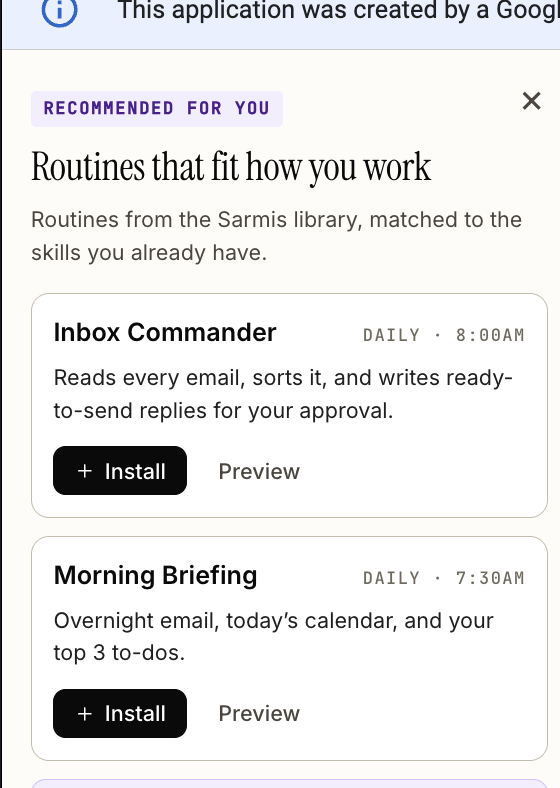
A candidate routine that is ready to review, not a blank workflow to build.
The user accepts, edits or dismisses the proposal.
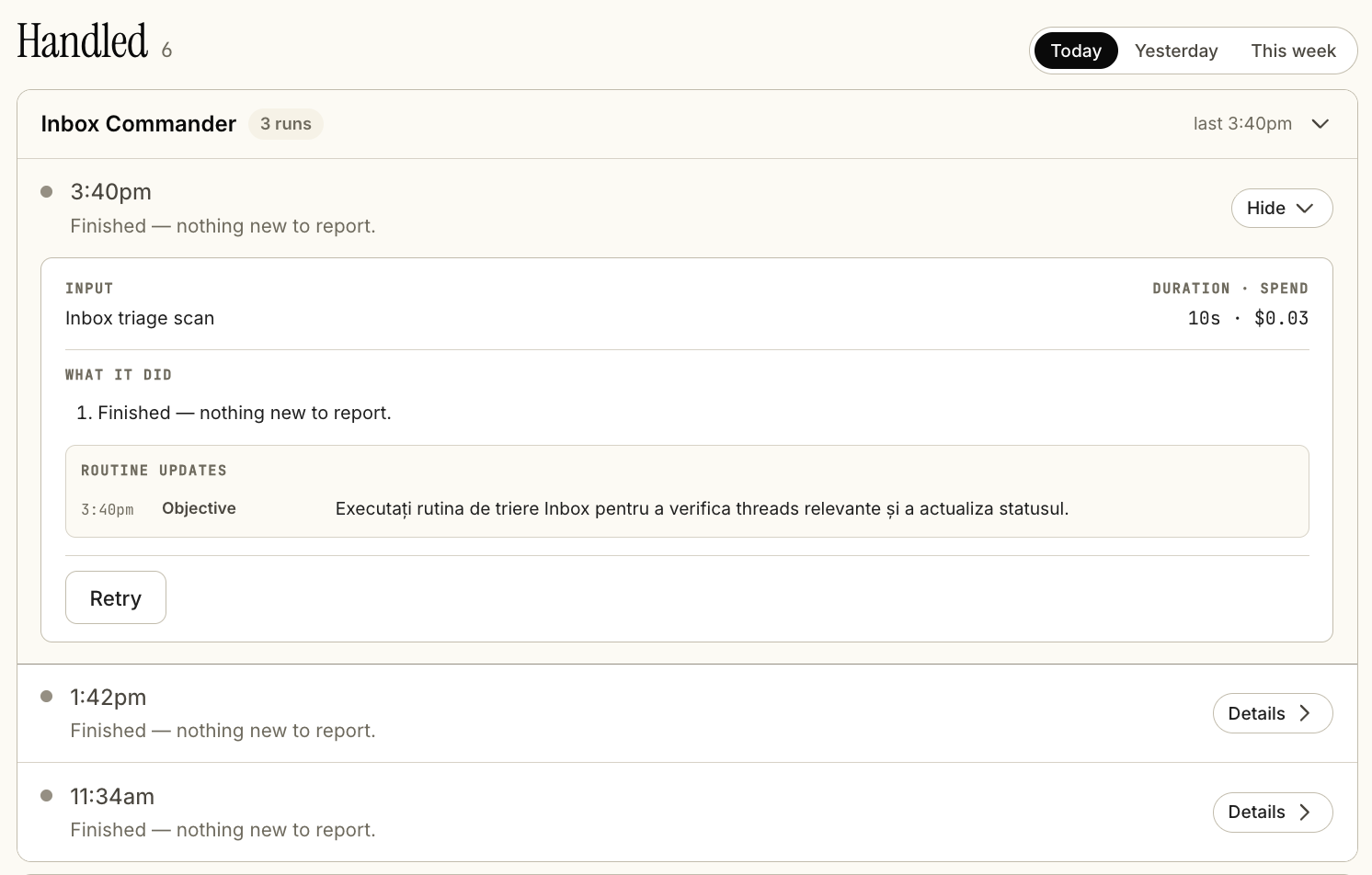
Approved routines run with controls and a record of what actually happened.
Demonstrated in live work
In an early cohort, people worked on their own data and normal workloads while PAERA observed, proposed and executed routines under human control.
The counts show that the system works in a real environment. Broader external validation is the next step.
Observed state and outcomes remain visible after every run.
The technology
Deriving an executable program from observed behaviour instead of a written specification. Existing approaches work best in closed domains with a bounded set of actions.
Discovering automatable work from interaction logs. Existing approaches typically expect structured traces and produce a specification that still needs engineering.
Open behaviour across changing business systems, without marked routine boundaries.
Discovery to execution in one pipeline, producing a live candidate routine.
Evidence-grounded proposals traceable to the work patterns that produced them.
Bounded autonomy
Autonomy is useful only when people can inspect, approve and stop it. PAERA treats those controls as part of the system, not as optional settings.
Outbound actions remain subject to explicit approval.
Every proposal is tied to the observed behaviour that produced it.
An execution journal records observed state, actions and outcomes.
Scheduled work remains stoppable through a persistent control.
Organisational data is scoped to the relevant enterprise environment.
Routines can be suspended, cancelled or withdrawn completely.
PAERA / NEXT VENTURE ACCEL